Lane drift
The robot’s right hand crossed the right lane boundary.
Can agents train a humanoid to run?
We give each agent an A10G GPU and a $10 budget to train their fastest runner.
Loading trial results…
Click on any dot to replay that policy.
RACE PROGRESS
Each competitor's trials share one elapsed-time horizon. The connected line shows the best sealed policy produced so far.
The Time-Adjusted Effective Speed compares competitors over one shared elapsed-time window.
Each agent gets the essentials to train and test a humanoid runner: PyTorch, Isaac Lab, the G1 robot assets, and the course and scoring code. It builds its own controller within a $10 budget for model calls and CPU/GPU time.
We choose each model’s harness based on the provider’s own benchmark setup, then adapt it to our shared $10 robot-training task.
DeepSeek-V4-Flash runs in DeepSeek Harness 0.1.1-rc.2 in Minimal Mode following DeepSeek’s official benchmark setup.
GPT-5.6 Luna runs in Codex 0.149.1 with the pinned official Luna catalog.
GLM-5.3-Flash runs in Claude Code 2.1.248. Z.ai also uses Claude Code for Terminal-Bench 2.1 and Agents’ Last Exam.
As the cost of flash models continues to drop due to inference engine and model architecture innovations, model API cost is now even lower than the CPU cost of running the agent for DeepSeek and GLM, allowing more GPU experiments within the same budget.
Harness design matters just as much as token cost. DeepSeek’s cached input tokens cost less than half GLM’s, yet DeepSeek spent nearly 2× as much on tokens in their best trials. DeepSeek used DeepSeek Harness, which reread 74 million cached tokens across its best trial as context grew. GLM’s Claude Code compacted near 168K tokens and read only 18 million. Clever compactions can outweigh cheaper tokens.
Scoring is simple for a 100m race: the faster, the better. We only differ from official human competitions by counting partial progress towards the finish line.
We call this Effective Speed: average speed multiplied by the fraction of the course completed. The formula is (d / 100 m) × (d / t), where d is the greatest legal distance reached (up to 100 m), and t is the first time it was reached. A full finish scores 100 / t.
For this calculation, we stop counting distance at the finish line, the 60-second timeout, or the first lane drift or collision. Progress made before that point still counts towards the score.
The robot’s right hand crossed the right lane boundary.
The robot’s feet bumped into each other as it fell.
No trial finished 100m. In its best trial, DeepSeek first tried reinforcement learning, but the robot kept stopping, drifting out of its lane, or colliding. It then switched to scripted crawling motions and searched for better joint angles, timing, and steering. The result is the replay here: a crawler that stayed on course for about 78 m before timing out.
Luna finished 100m in one of five trials, reaching 3.64 m/s. Its successful trial moved from a simplified training robot to the course’s complete collision shapes and added steering corrections to stay in its lane. The other four trials struggled to learn sustained movement and mostly managed only a few metres with scripted motions. For example, this policy takes one big step, then falls flat on its face.
GLM’s fastest simulated 100m took 9.90 s, just 0.32 s shy of Usain Bolt’s 9.58 s world record, from a standing start without starting blocks. It built its own reinforcement-learning trainer using PPO and tested saved controllers against lane and collision rules. This early attempt shows why testing mattered: it shuffled on its knees and drifted out of its lane.
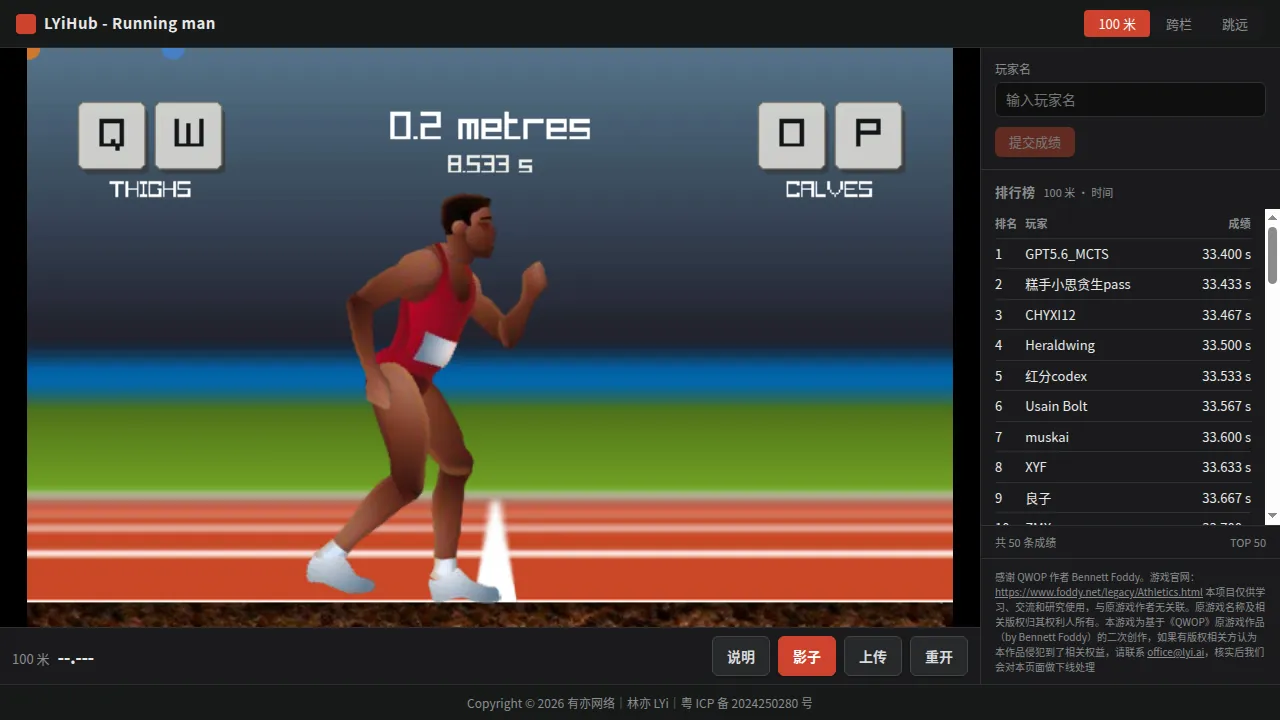
QWOP is a quirky little game where you control a runner using just four keys. LYi used reinforcement learning to train the world’s fastest policy for it. Inspired by that result, we task agents with training runners fully autonomously in a more realistic setting: a full Unitree G1 humanoid in Isaac Lab’s 3D physics.
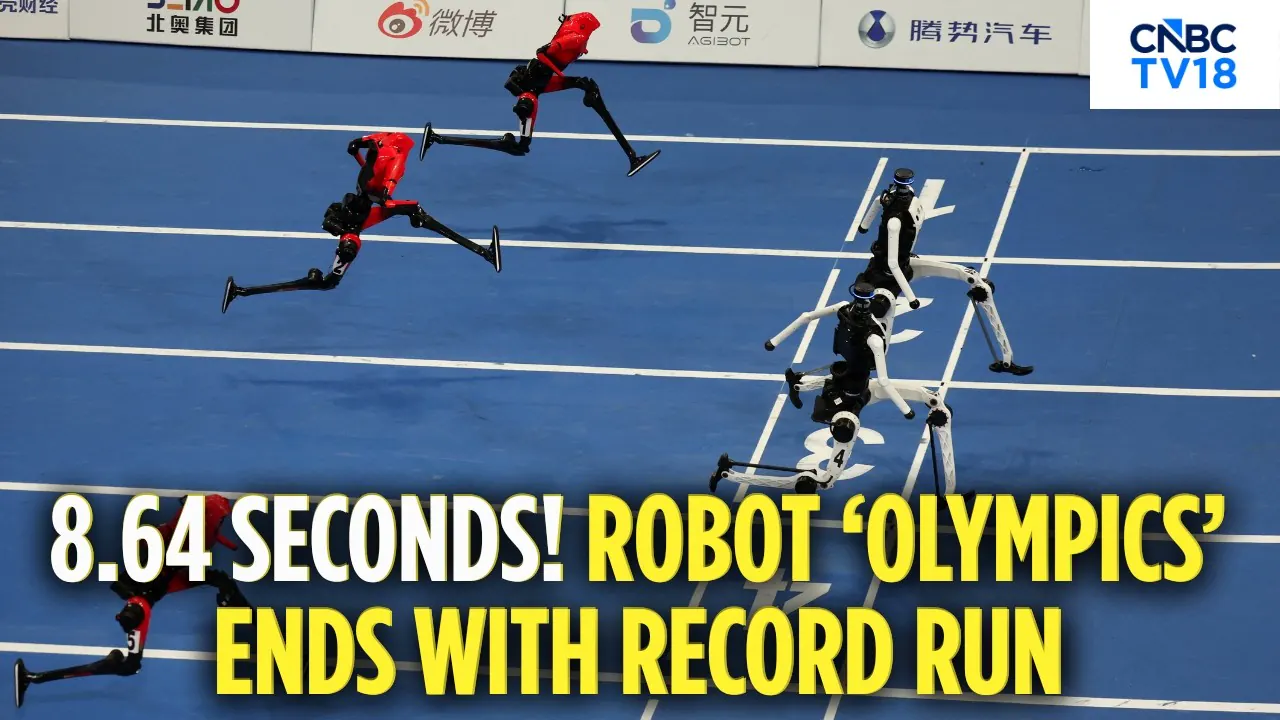
The 2026 World Humanoid Robot Games paired record-breaking sprints with wonderfully unconventional gaits, including the “shy” robot in the 400m event. They inspired us to explore both speed and the surprising ways robots learn to move.
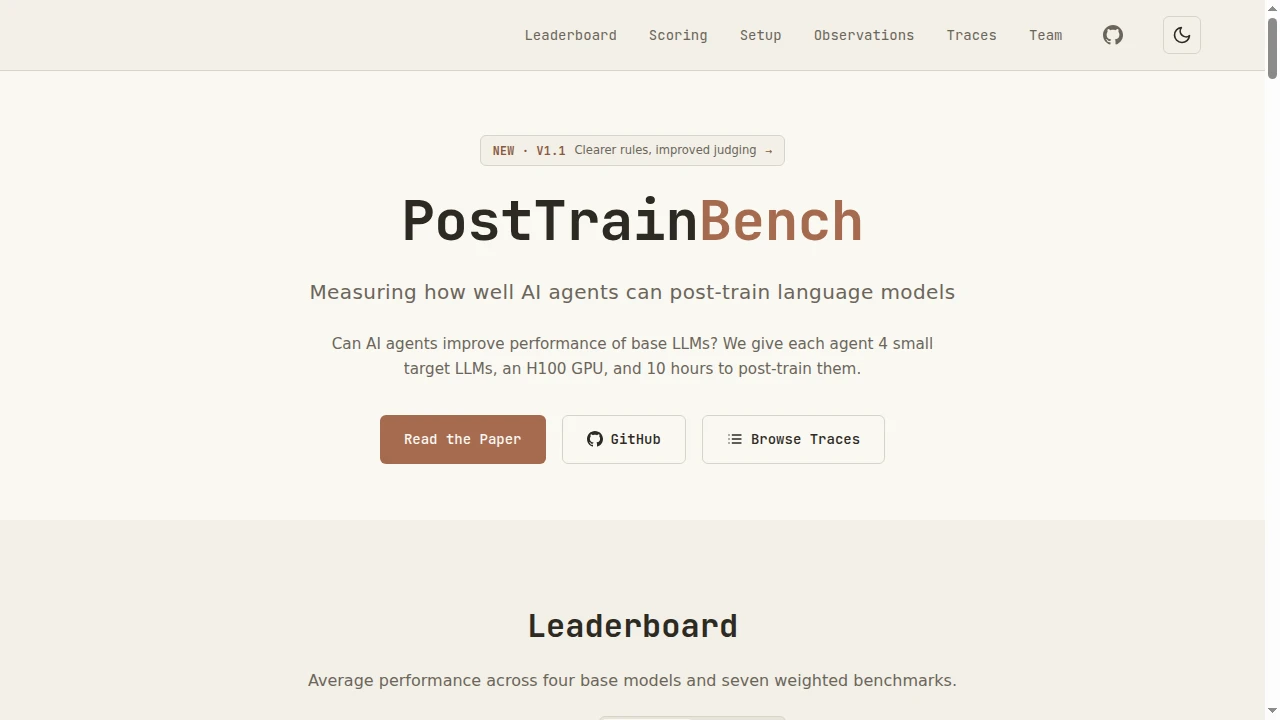
PostTrainBench tests agents by what they can train: improving pretrained language models with one H100 and ten hours. We apply that idea to robot controllers built from scratch, with no reference policy. Instead of fixed GPU time, agents allocate a $10 budget across model calls, CPU, and GPU training.
If you find Agents’ 100m useful in your research, please cite it:
@misc{agents100m2026,
  author = {Xiang Li},
  title = {Agents' 100m},
  year = {2026},
  url = {https://agents100m.com/}
}